
FMLA and Health Insurance: What Employers Must Do When an Employee Goes on Leave
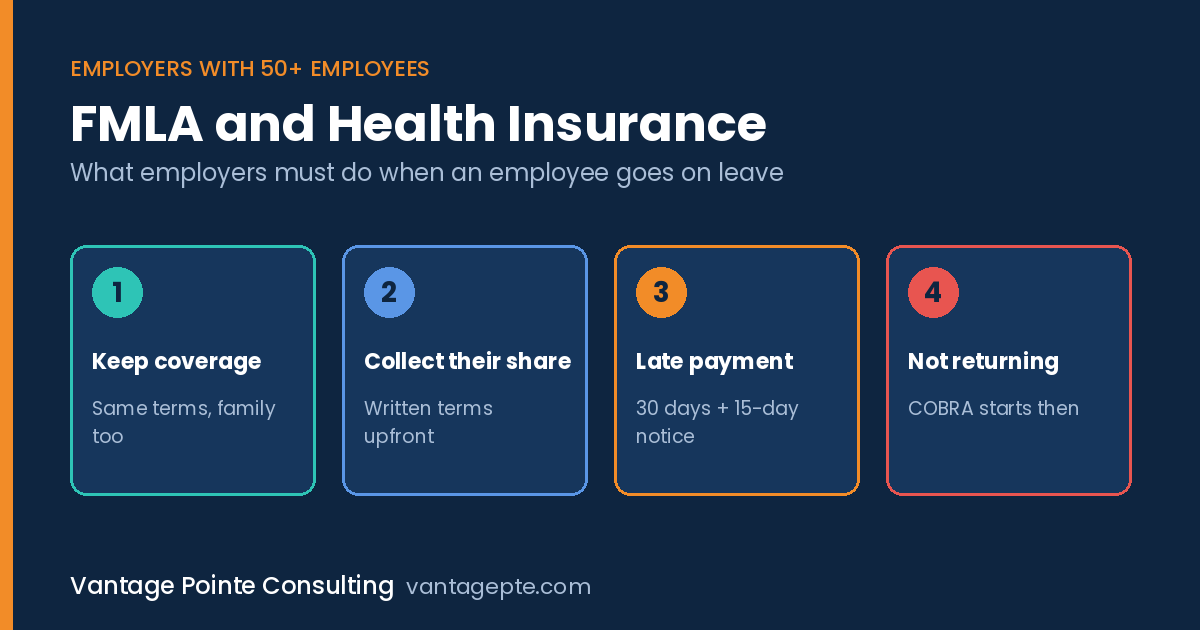
When an eligible employee takes FMLA leave, you must keep their group health coverage going on the same terms as if they were still working. You keep paying your share of the premium, the employee keeps paying theirs, and their spouse and children stay covered. If the employee doesn't come back, you may be able to recover your share of the premiums you paid during unpaid FMLA leave, and COBRA starts at that point, not when the leave began.
This guide walks through who qualifies, how to collect the employee's share while they're not on payroll, what to do if they stop paying, and what happens if they don't return. It's written for Florida employers with 50 or more employees, including construction and trades companies where injuries, surgeries, and new babies are a regular part of running a crew.
Does FMLA apply to your company?
The Family and Medical Leave Act (FMLA) applies to private employers with 50 or more employees for at least 20 workweeks in the current or previous calendar year. Unlike the ACA, the count includes part-time employees.
An individual employee is eligible if they:
- Have worked for you for at least 12 months (they don't have to be consecutive)
- Worked at least 1,250 hours in the 12 months before the leave starts
- Work at a location where you have 50 or more employees within 75 miles
That last rule matters for contractors with crews spread across job sites. Employees are generally counted at the site they report to or are assigned from, not wherever the current job happens to be.
If you're under 50 employees, FMLA doesn't apply to you. You may still choose to offer leave, but the rules in this article are not required. Florida doesn't have a separate family and medical leave law for private employers, so for most Florida businesses, federal FMLA is the rule that matters. If you're near 50 employees, our guide to the ACA employer mandate explains how headcount affects your other obligations too.
How much leave employees get
| Reason for leave | Maximum leave |
|---|---|
| Birth and bonding with a newborn, or placement of an adopted or foster child | 12 weeks in a 12-month period |
| The employee's own serious health condition | 12 weeks |
| Caring for a spouse, child, or parent with a serious health condition | 12 weeks |
| Certain needs arising from a family member's military deployment | 12 weeks |
| Caring for a family member who is a service member with a serious injury or illness | 26 weeks in a single 12-month period |
Leave can be taken all at once or, in some cases, intermittently, such as a few days a month for treatment. Health coverage must continue either way.
Rule #1: Keep health coverage going on the same terms
During FMLA leave, you must maintain the employee's coverage under your group health plan on the same conditions as if they had kept working. (29 CFR 825.209) In practice, that means:
- You keep paying your share of the premium, the same amount you'd pay if they were working.
- The employee keeps paying their share, the same amount they'd pay if they were working.
- Family coverage stays in place. If the employee had their spouse and kids on the plan, they stay on.
- Plan changes apply to them too. If your plan renews, premiums change, or you switch carriers during their leave, the employee gets the new plan and pays the new rates, just like everyone else.
- They can make changes at open enrollment if open enrollment happens during their leave.
"Group health plan" includes medical, dental, vision, and health FSAs that you sponsor. Other benefits, such as life insurance or disability, follow your normal policy for employees on unpaid leave, and the employee must be restored to them when they return.
Rule #2: How to collect the employee's share
This is where most small and mid-sized employers get stuck. When an employee is on paid leave (using PTO, for example), their share keeps coming out of their paycheck like normal. When the leave is unpaid, there's no paycheck to deduct from, so you need another way to collect.
The FMLA regulations allow several options. (29 CFR 825.210)
| Method | How it works |
|---|---|
| Pay on the payroll schedule | The employee sends their share on the same dates their payroll deduction would have come out. |
| Pay on the COBRA schedule | The employee pays monthly, on the same timing COBRA payments would follow. |
| Prepay through your Section 125 plan | If the employee chooses, they can prepay their share pre-tax before leave starts. |
| Use your existing unpaid-leave policy | Follow the same rules you use for other unpaid leave, as long as you don't require prepayment or charge more. |
| Voluntary agreement | You and the employee agree on something else, such as larger payroll deductions before a planned leave like a scheduled surgery or a due date. |
Three rules apply no matter which method you use:
- No extra charges. You can't add an administrative fee to the employee's premium.
- No stricter rules than other leave. You can't require more of an employee on FMLA leave than you do of employees on other unpaid leave.
- Put it in writing in advance. The employee must get written notice of the payment terms before the leave starts.
Running premiums through a Section 125 plan gives you the prepayment option and keeps the employee's share pre-tax. If you don't have one yet, our post on voluntary benefits and Section 125 explains how to set one up.
Rule #3: What to do if the employee stops paying
If the employee's share is more than 30 days late, your obligation to keep their coverage can end, but only after you follow a specific process. (29 CFR 825.212)
- Wait out the 30-day grace period (or longer, if your policy allows more).
- Mail a written notice that the payment hasn't been received.
- Give at least 15 days' warning. The notice must be mailed at least 15 days before coverage ends and state the date coverage will end if payment isn't received.
- End coverage only if payment still doesn't arrive by that date.
Many employers choose to keep paying the employee's share themselves instead of dropping coverage. That's allowed, and you can recover those payments when the employee returns to work.
Important: Even if coverage lapsed for nonpayment, when the employee returns you must restore their coverage, including family coverage, with no new waiting period, no medical questions, and no waiting for open enrollment. If your plan or carrier won't allow that, talk to your broker before you drop anyone.
Rule #4: What happens if the employee doesn't come back
Recovering the premiums you paid
If the employee doesn't return to work after FMLA leave, you can generally recover your share of the premiums you paid during unpaid FMLA leave. (29 CFR 825.213) There are two big exceptions. You can't recover premiums if the employee doesn't return because:
- Their own or a family member's serious health condition continues, or
- Of circumstances beyond their control, such as a spouse being transferred far away
You can require medical certification to support a health-related reason. An employee who returns and works for at least 30 calendar days is considered to have returned, so there's nothing to recover.
When COBRA starts
Taking FMLA leave is not a COBRA qualifying event. COBRA starts when the employee doesn't return: generally the last day of the FMLA leave, or earlier if the employee tells you they won't be coming back. The COBRA period is counted from that date, and you can't require the employee to repay their FMLA premiums as a condition of electing COBRA. Our article comparing COBRA and the Marketplace covers what your former employee's options look like from there.
A quick example
A Fort Myers roofing company with 65 employees has a foreman who needs knee surgery and will be out for 10 weeks, unpaid after his PTO runs out. He has family coverage that costs $1,900 a month. The company pays $1,200 and he pays $700.
- During PTO: his $700 comes out of his paycheck like normal.
- During unpaid leave: the company sends him a written notice before leave starts saying his $700 is due on the first of each month, matching their COBRA schedule. The company keeps paying its $1,200.
- If he misses a payment: after 30 days, the company mails a 15-day notice. Or the company pays his share and collects it through payroll deductions after he returns.
- If he returns: coverage continues with no gap or new waiting period.
- If he decides not to return for a reason unrelated to his health: the company may recover the $1,200 a month it paid during unpaid FMLA leave, and his COBRA period begins.
Employer checklist
- Confirm you have 50+ employees and the employee meets the 12-month, 1,250-hour, and 75-mile tests.
- Give the required FMLA notices, including written notice of how premiums will be paid.
- Keep paying your share of the premium.
- Choose a premium collection method and stick to it consistently.
- Track late payments and send the 15-day notice before ending coverage.
- Restore full coverage when the employee returns.
- Document the reason if an employee doesn't return, and handle COBRA from that date.
- Tell your broker and carrier about long leaves so eligibility isn't cut off by mistake.
Add these steps to your HR routine alongside our benefits compliance calendar.
Common mistakes
- Dropping coverage the day leave starts. Many carriers' eligibility rules say an employee must be "actively at work." FMLA overrides that for your obligations, so make sure your carrier knows the employee is on protected leave.
- Starting COBRA when leave begins. COBRA starts only if the employee doesn't return.
- Charging the employee the full premium. They pay only their normal share.
- Ending coverage without the 15-day notice.
- Making the employee requalify for coverage when they come back.
How we can help
We help Southwest Florida employers with 50 or more employees, especially construction and trades companies, set up their group health plans so leave, eligibility, and COBRA are handled correctly. That includes confirming how your carrier treats employees on leave, setting up a Section 125 plan for premium prepayment, and making sure nobody's coverage gets cut off by mistake.
Want to make sure your plan is ready the next time someone goes on leave? Request a free benefits analysis and we'll review it with you.
Frequently asked questions
Do employers have to pay health insurance during FMLA leave? Yes. You must keep paying your share of the premium and maintain coverage on the same terms as if the employee were working.
Does the employee still pay their share during FMLA? Yes. They pay the same share they paid while working. If the leave is unpaid, you collect it on a schedule set out in a written notice before leave starts.
Can I cancel an employee's health insurance during FMLA if they don't pay? Only if their payment is more than 30 days late and you mail a written notice at least 15 days before coverage ends. You must restore coverage when they return.
Is FMLA leave a COBRA qualifying event? No. COBRA starts only if the employee doesn't return from leave, generally on the last day of the leave or when they say they won't be returning.
Can I recover premiums if the employee quits after FMLA leave? Usually you can recover your share of premiums paid during unpaid FMLA leave, unless they didn't return because of a continuing serious health condition or another circumstance beyond their control.
This article is for general educational purposes and isn't legal advice. Talk with an employment attorney about specific situations.
Sources: 29 CFR 825.209 — Maintenance of group health benefits · 29 CFR 825.210 — Employee payment of premiums · 29 CFR 825.212 — Failure to pay premiums · 29 CFR 825.213 — Recovery of premiums
Roger Aboytes
Licensed Benefits Consultant · Vantage Pointe Consulting · Southwest Florida
Roger Aboytes is a licensed independent benefits consultant serving individuals, families, and businesses across Southwest Florida. He helps clients compare health coverage options and design employee benefits strategies that fit their needs. Roger works directly with clients in Cape Coral, Fort Myers, Naples, Bonita Springs, and surrounding communities.
View license & credentials →