
Reference-Based Pricing Explained: How Small Businesses Can Pay Hospitals Like Big Corporations Do
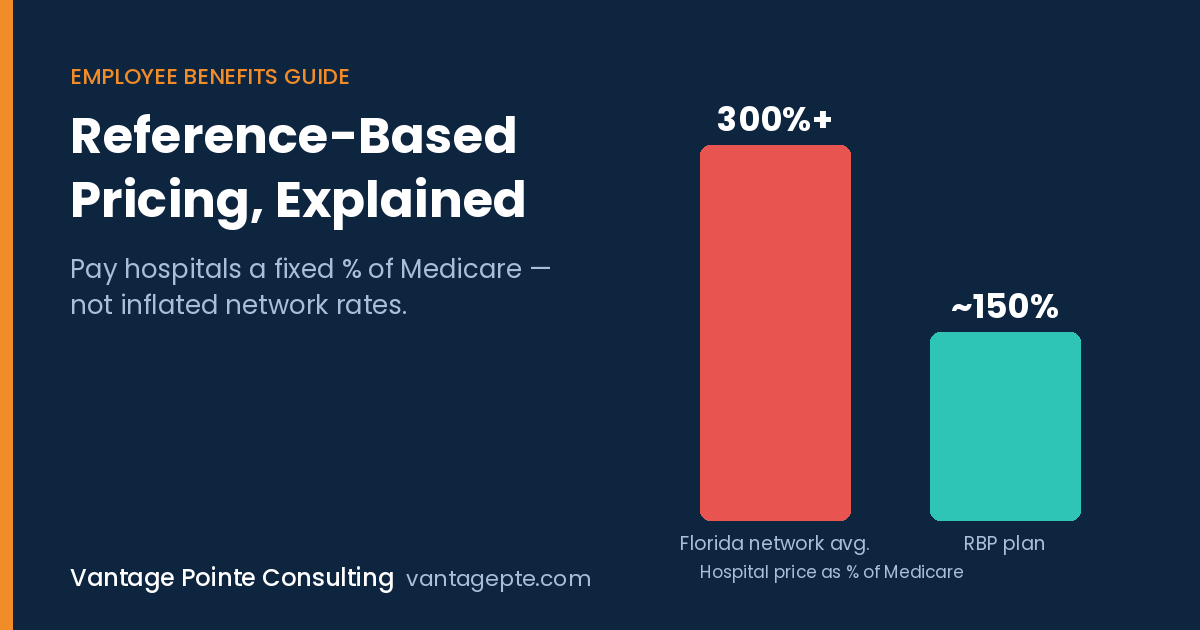
Reference-based pricing (RBP) is a way of paying hospitals a fixed percentage of what Medicare pays for the same service — usually somewhere between 120% and 200% of Medicare — instead of accepting whatever "discount" an insurance network negotiated off the hospital's sticker price. For a small or mid-sized business, it's one of the few tools that attacks the biggest driver of rising premiums directly: what hospitals charge.
Large employers have used this approach for years. Most small business owners in Southwest Florida have never heard of it, because the traditional broker model is built around quoting carriers, not changing how claims get paid. This article explains how reference-based pricing works, what it can save, where the real risks are, and how to tell whether it fits your company.
What is reference-based pricing?
In a traditional health plan, the insurance carrier negotiates contracts with hospitals and doctors. The hospital sets a list price (its "chargemaster" rate), and the carrier's contract gives it a percentage off that list price. You never see the actual math. You just see the renewal.
Reference-based pricing flips that around. Instead of starting from the hospital's list price, the plan starts from a public, published benchmark — Medicare's payment rate for that exact service at that exact facility — and pays a set multiple of it. If the plan pays 150% of Medicare, the hospital receives one and a half times what Medicare would have paid. That is still a profit margin for the hospital. It just isn't three times Medicare.
RBP is almost always paired with a level-funded or self-funded health plan [blocked], because those plans pay claims from the employer's own funding and use a third-party administrator (TPA) to process them. A fully insured plan can't do this; the carrier controls the contracts.
Why hospital prices are the real problem
If you've read our breakdown of why traditional fully insured plans are broken [blocked], you know premiums follow claims, and claims follow prices. Hospitals are the largest piece of that.
The RAND Corporation runs the largest employer-led study of what private health plans actually pay hospitals. In its most recent round, using 2022 data, private plans paid hospitals an average of 254% of what Medicare would have paid for inpatient services and 279% for outpatient services. Florida was one of the states where commercial hospital prices averaged above 300% of Medicare. (RAND, Round 5.1)
RAND also found that most of the price variation between hospitals is explained by market power — how much of a local market a hospital system controls — not by quality or by how many Medicare and Medicaid patients it serves. In a region like Southwest Florida, where a handful of systems dominate, that matters. (For more on what's driving local costs, see our post on Southwest Florida healthcare costs heading into 2027 [blocked].)
In plain terms: a small employer in Fort Myers or Naples on a traditional network plan is often paying hospitals three times the Medicare rate and has no visibility into it.
How reference-based pricing works, step by step
- The employer sets up a level-funded or self-funded plan with a TPA, stop-loss insurance to cap large claims, and an RBP vendor.
- The plan document defines the payment rule — for example, facility claims paid at 150% of Medicare.
- An employee gets care. For a hospital stay or outpatient procedure, the hospital submits its bill like normal.
- The RBP vendor reprices the claim to the plan's Medicare multiple and the TPA pays that amount.
- The hospital either accepts the payment (most claims) or disputes it. If it disputes, the plan's advocacy and legal team negotiates or defends the claim so the employee isn't stuck in the middle.
- Employees pay their normal cost share — deductible, copay, coinsurance — based on the plan design.
A simple example
The numbers below are illustrative, not a quote, but the ratios reflect the RAND findings above.
| Scenario | Payment basis | Paid for a procedure Medicare prices at $10,000 |
|---|---|---|
| Traditional network plan (Florida average) | ~300% of Medicare | ~$30,000 |
| Reference-based pricing plan | 150% of Medicare | $15,000 |
| Difference on one claim | ~$15,000 |
Multiply that across every hospital claim your group has in a year and you can see why employers who move to RBP often report total plan savings in the 20%–40% range. Your result depends on your own claims history and which hospitals your employees use.
Reference-based pricing vs. a traditional network plan
| Traditional network plan | Reference-based pricing plan | |
|---|---|---|
| How hospitals are paid | Discount off the hospital's list price | Fixed percentage of Medicare |
| Price visibility | Contract rates mostly hidden | Benchmark is public and auditable |
| Who controls the rules | The carrier | The employer, through the plan document |
| Leftover money in a good year | Kept by the carrier | Often returned to the employer (level-funded) |
| Main risk | Rising renewals you can't explain | Balance billing if the plan has weak advocacy |
The real risk: balance billing, and how good plans handle it
Any honest conversation about RBP has to cover balance billing. Because there's no network contract with the hospital, the hospital can bill the patient for the difference between its charge and what the plan paid. Most hospitals accept the payment and move on. Some don't.
The federal No Surprises Act protects patients from balance billing for emergency care and certain other situations, but it doesn't eliminate the risk for every non-emergency service under an RBP plan. That's why the quality of the program matters more than the percentage on paper.
A well-built RBP plan includes:
- Member advocacy — a team the employee calls the moment they get a bill they don't understand.
- Legal defense — the vendor, not the employee, negotiates with the hospital and handles any collections or legal threats.
- Navigation before care — helping employees choose facilities that are known to accept RBP payments, especially for planned procedures.
- Clear employee communication — ID cards, instructions, and a simple "don't pay that bill, call us" message.
This is the same reason we put so much weight on healthcare advocacy [blocked]. The broken medical billing system we covered in this article [blocked] doesn't go away with RBP; you just get a team on your side of it.
Full RBP vs. hybrid designs
Not every RBP plan is all-or-nothing. The common designs are:
- Full RBP: every claim, including doctor visits, is paid at a Medicare multiple. Lowest cost, but the most employee education required.
- Hybrid (facility-only RBP): employees keep a physician network for office visits and specialists, while hospital and facility claims are paid at a Medicare multiple. Hospital claims are where most of the money is, so this often captures most of the savings with less disruption.
- RBP plus direct contracts: the plan signs direct agreements with specific hospitals or surgery centers at a set Medicare multiple, which removes balance-billing risk at those facilities.
For most construction and trades companies we work with, a hybrid design is the easiest starting point. Crews keep their doctors, and the owner stops overpaying hospitals.
Is reference-based pricing right for your company?
RBP tends to fit well when:
- You have a group health plan and your renewals keep climbing without a clear reason.
- Your employees are generally healthy, or your claims are driven by a few large hospital events.
- You want visibility into where your money goes, not just a bigger renewal letter each year.
- You're willing to spend 30 minutes making sure employees know how to use the plan.
It may not fit if most of your employees need ongoing care at a single hospital system that refuses RBP payments, or if you're not ready to move off a fully insured plan. Minimum group sizes vary by vendor, so the only way to know is to run the numbers on your census and claims. If you run a construction company, our page on employee benefits for construction companies [blocked] covers how we approach crews specifically.
Five questions to ask before you sign an RBP plan
- What percentage of Medicare does the plan pay for facilities, and for physicians?
- What happens, step by step, when an employee gets a balance bill?
- Is the legal defense included, or is it an extra fee?
- Which local hospitals and surgery centers have accepted your payments in the past year?
- What does stop-loss cover, and what is our maximum annual cost in a bad year?
If a broker or vendor can't answer these clearly, that tells you something.
How Vantage Pointe uses reference-based pricing
We don't sell RBP as a one-size product. We start with your current plan, census, and claims data, compare what you're paying now to what an RBP or hybrid design would pay, and show you the trade-offs in plain language — including the risks. If it doesn't make sense for your group, we'll tell you.
Want to see what your company is actually paying hospitals? Request a free benefits analysis [blocked] and we'll show you where the money goes before your next renewal.
Frequently asked questions
What is reference-based pricing in health insurance?
It's a way for self-funded or level-funded plans to pay hospitals a set percentage of what Medicare pays for the same service, typically 120% to 200%, instead of a network discount off the hospital's list price.
Can a small business use reference-based pricing?
Yes. RBP is usually built into a level-funded or self-funded plan, and many of those programs are available to small and mid-sized employers. Minimum group sizes vary by vendor.
What is balance billing under an RBP plan?
It's when a provider bills the patient for the difference between its charge and what the plan paid. Good RBP plans include advocacy and legal support so employees don't handle those bills alone.
Do employees lose their doctors with reference-based pricing?
Not necessarily. Hybrid designs keep a physician network for doctor visits and apply RBP only to hospital and facility claims.
How much can reference-based pricing save?
It depends on your claims and local hospital prices. With Florida hospital prices averaging over 300% of Medicare in RAND's 2022 data, paying a fixed rate closer to 150% can cut hospital spending substantially.
This article is for general educational purposes and isn't legal, tax, or medical advice. Plan availability and results vary by group.
Sources: RAND Round 5.1 hospital price study · IMA — No Surprises Act guidance for reference-based plans
Roger Aboytes
Licensed Benefits Consultant · Vantage Pointe Consulting · Southwest Florida
Roger Aboytes is a licensed independent benefits consultant serving individuals, families, and businesses across Southwest Florida. He helps clients compare health coverage options and design employee benefits strategies that fit their needs. Roger works directly with clients in Cape Coral, Fort Myers, Naples, Bonita Springs, and surrounding communities.
View license & credentials →