
ACA Affordability Safe Harbors for 2027: How Much Employers With 50+ Employees Can Charge for Health Coverage
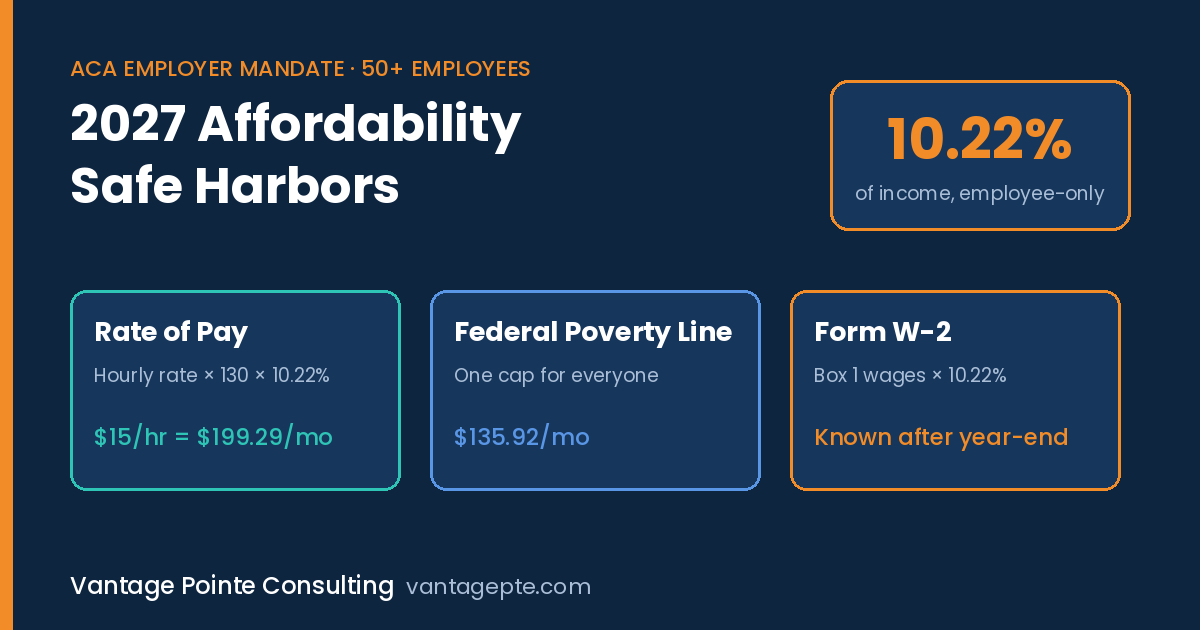
If your company has 50 or more full-time employees, offering health insurance isn't enough to avoid ACA penalties. The coverage also has to be affordable. For 2027, that means a full-time employee can't be required to pay more than 10.22% of their income for employee-only coverage on your lowest-cost plan that meets minimum value.
Because you don't know your employees' household income, the IRS gives you three safe harbors that use numbers you do have: an employee's W-2 wages, their rate of pay, or the federal poverty line. Meet one of them and the coverage counts as affordable, even if it wouldn't be by the employee's actual household income.
This guide explains each safe harbor with 2027 numbers and worked examples, clears up a common misunderstanding about family coverage, and shows what's at stake if you get it wrong.
Who this applies to
The affordability rules apply to applicable large employers (ALEs): businesses that averaged 50 or more full-time employees, including full-time equivalents, during the prior calendar year. A full-time employee is anyone averaging 30 or more hours a week (130 hours a month).
If you're near that line, our guide to the ACA employer mandate explains how to count. Businesses under 50 aren't subject to these rules.
The 2027 numbers at a glance
| Item | 2026 | 2027 |
|---|---|---|
| Affordability percentage | 9.96% | 10.22% |
| FPL safe harbor maximum (mainland, calendar-year plans) | $129.89/month | $135.92/month |
| 4980H(a) penalty (no offer to 95%) | $3,340/year | $3,780/year |
| 4980H(b) penalty (unaffordable or inadequate coverage) | $5,010/year | $5,670/year |
The IRS set the 2027 affordability percentage in Revenue Procedure 2026-26, the highest it has ever been. The 2027 penalty amounts come from Revenue Procedure 2026-22.
What "affordable" actually means
Three details trip up a lot of employers:
- It's measured on employee-only coverage. Not employee + spouse, not family.
- It's measured on your lowest-cost plan that provides minimum value, not the plan the employee picks. If you offer three plans, test the cheapest one that meets minimum value.
- Minimum value means the plan pays at least 60% of covered costs and includes substantial hospital and physician coverage. Most standard group medical plans meet it; some "skinny" plans don't.
So the question for each full-time employee is simple: What would this person pay per month for employee-only coverage on our cheapest minimum-value plan? The safe harbors tell you the maximum that number can be.
Safe harbor 1: Rate of pay
This is the safe harbor most employers with hourly workforces use, and it's what people usually mean when they say affordability is "based on your lowest-paid employee."
For hourly employees: hourly rate × 130 hours × 10.22% = the maximum monthly employee contribution.
For salaried employees: monthly salary × 10.22% = the maximum monthly employee contribution.
Example: hourly crew in Florida
Florida's minimum wage rose to $15 an hour on September 30, 2026. If your lowest-paid full-time employee makes $15 an hour:
| Step | Calculation |
|---|---|
| Monthly pay under the safe harbor | $15 × 130 = $1,950 |
| Maximum employee contribution | $1,950 × 10.22% = $199.29/month |
If every full-time employee pays $199.29 or less for employee-only coverage on your cheapest minimum-value plan, your coverage is affordable for everyone, because everyone else earns more. That's why many employers set one contribution based on their lowest hourly rate.
For an $18-an-hour employee, the limit would be $18 × 130 × 10.22% = $239.14 a month.
Example: salaried employee
A salaried project coordinator earning $3,500 a month: $3,500 × 10.22% = $357.70/month maximum.
Rules to know
- For hourly employees, use the lowest hourly rate the employee had during the month.
- For salaried employees, you can't use this safe harbor if you reduced their monthly salary during the year.
- It works month by month, so you know before the year starts whether you pass. That's its biggest advantage.
Safe harbor 2: Federal poverty line (FPL)
The FPL safe harbor gives you one maximum contribution for everyone, no matter what they earn. It's the simplest to run.
For calendar-year 2027 plans, employers can use the 2026 poverty guideline for one person in the mainland U.S., $15,960:
$15,960 × 10.22% ÷ 12 = $135.92 per month (many advisors round down from $135.93 to stay safe). (Mercer)
If no full-time employee pays more than $135.92 a month for employee-only coverage on your cheapest minimum-value plan, you pass. Employers with plan years starting later in 2027 can use the 2027 poverty guideline once it's published, which will likely allow a slightly higher amount.
The trade-off: it's simple but strict. Compare it with the rate of pay example: $135.92 under FPL versus $199.29 under rate of pay for a $15-an-hour employee. If your lowest wage is well above the poverty line, rate of pay usually lets employees pay more and costs the business less.
Safe harbor 3: Form W-2
Under the W-2 safe harbor, coverage is affordable if the employee's annual contribution for employee-only coverage doesn't exceed 10.22% of their Box 1 wages on the W-2 you issue for that year.
For example, if an employee's Box 1 wages are $31,200, the most they can pay for the year is $31,200 × 10.22% = $3,188.64, or about $265.72 a month.
The drawbacks:
- You won't know until after the year ends, when W-2s are final.
- Box 1 is after pre-tax deductions. Section 125 premiums and 401(k) deferrals lower Box 1, which lowers the limit. (More on that in our Section 125 guide.)
- Hours can drop. If a full-time employee works fewer hours than expected, their W-2 shrinks and coverage can fail the test after the fact.
- It only applies cleanly to employees offered coverage for the whole year; partial years are prorated.
It works best for stable, well-paid workforces, not seasonal or variable-hour crews.
Comparing the three safe harbors
| Rate of pay | Federal poverty line | Form W-2 | |
|---|---|---|---|
| 2027 limit | 10.22% of hourly rate × 130, or monthly salary | $135.92/month for everyone | 10.22% of Box 1 wages |
| Know in advance? | Yes | Yes | No, only after year-end |
| Room to charge employees | Medium to high | Lowest | Varies |
| Best for | Hourly workforces, construction and trades | Low-wage workforces or employers who want simplicity | Stable salaried workforces |
| Main risk | Pay cuts for salaried staff | Higher cost to the employer | Hours or pre-tax deductions shrinking wages |
You don't have to use the same safe harbor for everyone. You can apply different safe harbors to reasonable categories of employees, such as hourly and salaried, as long as you apply each one consistently within its category. You can't pick a different one employee by employee.
What about family coverage?
This is the most common misunderstanding we hear. For the employer mandate, affordability is tested only on employee-only coverage. You do not have to make spouse or family coverage affordable, and you aren't required to contribute toward it to avoid the affordability penalty.
What you are required to do:
- Offer coverage to dependent children (up to age 26) to satisfy the 4980H(a) "offer" requirement. Spouses don't have to be offered coverage for this purpose.
- Offer it to at least 95% of full-time employees.
Where family costs do matter is for your employees' families. Since a 2023 IRS rule change, sometimes called the "family glitch" fix, family members can qualify for Marketplace subsidies if the cost of family coverage is more than the affordability percentage of household income, even when the employee's own coverage is affordable. That doesn't create a penalty for you, but it can affect which of your employees keep their families on your plan. Contributing toward dependent coverage is still a strong recruiting and retention tool, especially for construction companies competing for skilled workers.
What's at stake: the 2027 penalties
| Penalty | When it applies | 2027 amount |
|---|---|---|
| 4980H(a) | You don't offer coverage to at least 95% of full-time employees (and their dependent children), and at least one full-time employee gets a Marketplace premium tax credit | $3,780 per year for every full-time employee, minus the first 30 |
| 4980H(b) | You do offer coverage, but it's unaffordable or doesn't meet minimum value for a full-time employee who then gets a premium tax credit | $5,670 per year for each employee who gets a credit, capped at the (a) amount |
Penalties are calculated monthly ($315 and $472.50 a month for 2027). The (b) penalty only applies to employees who actually get a premium tax credit on the Marketplace, which is why lower-paid employees, the ones most likely to qualify, are where affordability matters most. With Florida's high Marketplace enrollment, that risk is real. Our post on ACA employer penalties covers how the IRS assesses them.
How to set your 2027 contributions: step by step
- Confirm you're an ALE based on your 2026 headcount.
- Identify your lowest-cost plan that provides minimum value and its 2027 employee-only premium.
- Choose your safe harbor(s) by employee category.
- Find the most you can charge. For rate of pay, use your lowest hourly rate and lowest salary in each category. For FPL, use $135.92.
- Set the employee contribution at or below that number and make up the rest of the premium as the employer contribution.
- Document your choice and keep payroll records that support it.
- Report it correctly on Form 1095-C. Line 16 uses code 2F for the W-2 safe harbor, 2G for FPL, and 2H for rate of pay.
- Recheck when pay or premiums change, such as raises, minimum wage increases, or renewals.
Add these steps to your year-end routine with our benefits compliance calendar.
Example: putting it together
A Cape Coral contractor with 60 full-time employees has a lowest hourly rate of $15. Its cheapest minimum-value plan costs $650 a month for employee-only coverage.
- Rate of pay limit: $199.29 a month.
- If the employer pays $450 and the employee pays $200, coverage fails by 71 cents for the $15-an-hour employees.
- If the employer pays $451 and the employee pays $199, coverage is affordable for everyone.
Small numbers, big consequences: if 10 of those employees got premium tax credits on unaffordable coverage, the (b) penalty could reach $56,700 for the year.
Ways to lower the cost of staying affordable
If meeting the affordability limit is straining your budget, there are design options worth reviewing:
- Offer a lower-cost minimum-value plan as the base option, with richer plans as buy-ups. Affordability is tested only on the cheapest qualifying plan.
- Consider a level-funded plan, which can lower the premium you have to cover.
- Look at an ICHRA, which has its own affordability calculation based on Marketplace silver plan prices. See ICHRA explained.
How we can help
We help Southwest Florida employers with 50 or more employees choose the right safe harbor, set contributions that pass the affordability test without overpaying, and keep the numbers current when wages or premiums change. Learn more about our approach to group health insurance.
Not sure your 2027 contributions are affordable? Request a free benefits analysis and we'll run the numbers for your workforce.
Frequently asked questions
What is the ACA affordability percentage for 2027? 10.22%, up from 9.96% in 2026. Coverage is affordable if the employee's cost for employee-only coverage on the lowest-cost minimum-value plan doesn't exceed that share of income.
What are the three affordability safe harbors? Form W-2 (Box 1 wages), rate of pay (hourly rate × 130, or monthly salary), and federal poverty line (one maximum for everyone).
What is the 2027 FPL safe harbor amount? About $135.92 a month for calendar-year plans in the mainland U.S.
Does family coverage have to be affordable? No. Affordability is tested on employee-only coverage. You must offer coverage to dependent children, but you don't have to make it affordable or contribute toward it.
What is the 2027 penalty for unaffordable coverage? $5,670 a year ($472.50 a month) for each full-time employee who gets a premium tax credit, capped at the 4980H(a) amount.
This article is for general educational purposes and isn't legal or tax advice. Talk with your tax advisor about your specific situation.
Sources: IRS Revenue Procedure 2026-26 · Mercer — 2027 affordability percentage · CBIZ — 2027 penalty amounts
Roger Aboytes
Licensed Benefits Consultant · Vantage Pointe Consulting · Southwest Florida
Roger Aboytes is a licensed independent benefits consultant serving individuals, families, and businesses across Southwest Florida. He helps clients compare health coverage options and design employee benefits strategies that fit their needs. Roger works directly with clients in Cape Coral, Fort Myers, Naples, Bonita Springs, and surrounding communities.
View license & credentials →