
Captive Insurance for Small Employers: How to Self-Fund Your Health Plan Without Taking On All the Risk
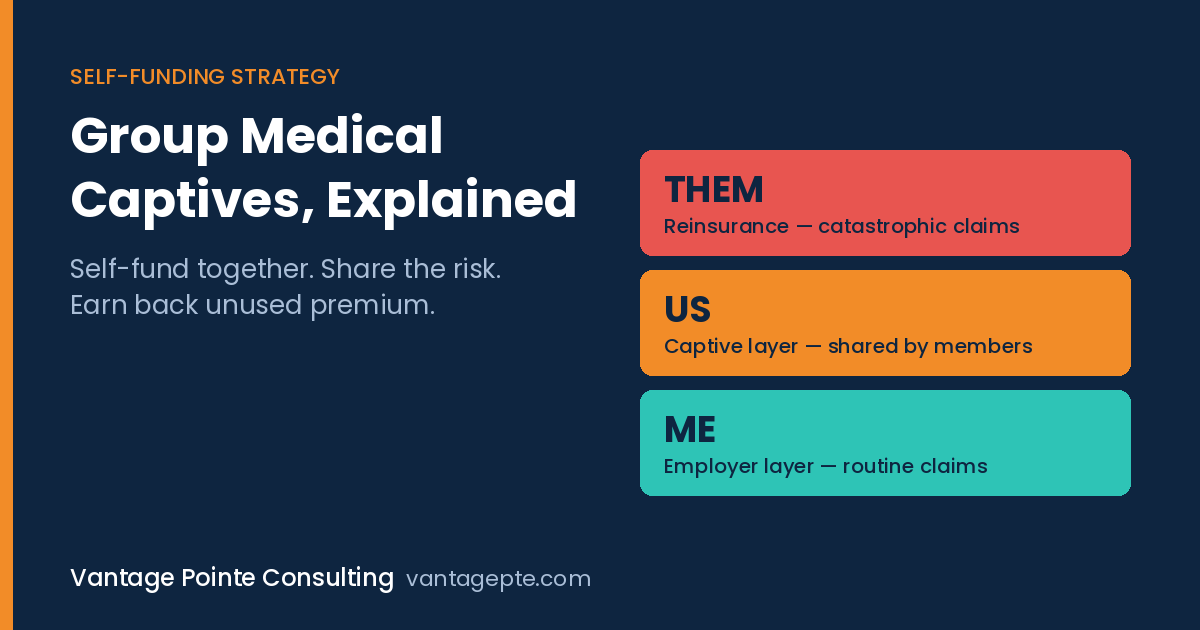
A group medical stop-loss captive lets a group of mid-sized employers self-fund their health plans together. Each company pays its own everyday claims, the group shares a middle layer of larger claims, and a reinsurer covers the catastrophic ones. When the group's claims come in better than expected, members get money back. It's how many companies in the 50–500 employee range get the control and savings of self-funding without betting the business on one bad year.
If you've hit a wall with renewals — or you've already tried a level-funded plan and want the next step — this is worth understanding. Here's how captives work, who they fit, and what can go wrong.
Why employers look at captives in the first place
On a fully insured plan, you pay a fixed premium and the carrier keeps whatever it doesn't spend on claims. You can't see your data, and you don't share in a good year. We've covered why that model is broken [blocked].
Self-funding fixes that: you pay actual claims, you see your data, and you keep the savings. But a small or mid-sized company that self-funds alone faces one big problem — volatility. One premature baby, cancer diagnosis, or transplant can swing your costs by hundreds of thousands of dollars. Stop-loss insurance limits that, but stop-loss carriers price small groups cautiously and can raise rates sharply after a single large claim.
A captive is the middle ground: you self-fund, but you smooth out the volatility by pooling it with other employers.
What is a captive?
In insurance, a "captive" is an insurance company owned by the businesses it insures. Large corporations have used captives for decades for workers' comp, liability, and property coverage. A group captive is one owned by several unrelated employers who pool their risk.
In employee benefits, the most common version is a group medical stop-loss captive. The captive doesn't replace your health plan. Each employer keeps its own separate self-funded plan, with its own plan design, deductibles, and copays. What's shared is part of the stop-loss coverage that protects those plans from large claims.
How a group medical stop-loss captive works: the three layers
Captive professionals often describe the structure from the employer's point of view as "me, us, and them."
| Layer | Who pays | Example range per person per year |
|---|---|---|
| Me — employer layer | Your company's plan, from its own claims fund | $0 up to your specific deductible (e.g., $50,000) |
| Us — captive layer | The captive, funded by all members' stop-loss premiums | Above your deductible up to a cap (often $250,000–$500,000) |
| Them — reinsurance layer | A stop-loss carrier or reinsurer | Everything above the captive cap |
The dollar amounts above are illustrative; each captive and each member sets its own levels. (Business Insurance)
Here's the flow in practice:
- Your company sets up a self-funded plan with a third-party administrator, a provider network or reference-based pricing [blocked], pharmacy benefits, and stop-loss coverage.
- You choose a specific deductible — the amount you'll pay on any one person's claims before stop-loss kicks in. Higher deductibles mean lower stop-loss premiums and more risk kept in-house.
- You also carry aggregate stop-loss, which caps your total claims for the year, typically around 125% of expected claims.
- Part of your stop-loss premium funds the captive layer. When any member has a large claim above its deductible, the captive pays its share.
- At year-end, after claims run out, the captive's results are calculated. If pooled claims were lower than projected, the surplus plus investment income can be returned to members as dividends.
The benefits
- Stability. Pooling the middle layer across many employers smooths out the one-bad-year problem that makes small groups' stop-loss renewals unpredictable.
- Money back in good years. Unused premium in the captive layer comes back to members instead of becoming carrier profit.
- Control. Each employer chooses its own plan design, TPA, network or pricing strategy, and cost-containment tools.
- Transparency. Self-funded plans give you claims data, so you can see what's actually driving costs and fix it.
- Better behavior. Members are usually required to use cost-containment programs — pharmacy management, care navigation, large-claim review — because everyone shares the results.
The risks you need to understand
Anyone selling a captive without walking you through these isn't being straight with you.
- Collateral. Members usually post collateral, often a letter of credit or cash, to guarantee they can cover their share of a bad year. That's money you set aside.
- Shared losses. Pooling cuts both ways. If another member has a terrible year within the captive layer, it affects everyone's results.
- Delayed dividends. Dividends are paid after claims for a policy year are settled, which can take a year or more.
- Multi-year commitment. Captives work best over three to five years. One year in and out won't show the real value.
- Underwriting. Captives screen members carefully. A group with a known high-cost condition may not be accepted or may face a higher deductible.
- Complexity. There are more moving parts than a fully insured plan: TPA, PBM, stop-loss carrier, captive manager, and your advisor. You need someone coordinating them.
Captive vs. level-funded vs. fully insured
| Fully insured | Level-funded | Group captive | |
|---|---|---|---|
| Typical size | Any | Small groups and up | Roughly 50–500 covered employees |
| Who keeps a good year's savings | The carrier | Usually shared with or refunded to the employer | The employer, plus captive dividends |
| Claims data access | Limited | Usually available | Full |
| Plan design control | Carrier's menu | Moderate | High |
| Stop-loss renewal volatility | Built into premium | Can be high after a big claim | Smoothed by the pool |
| Collateral required | No | No | Usually yes |
Most companies don't jump straight from fully insured to a captive. A common path is fully insured → level-funded [blocked] → captive as the group grows and builds clean claims history.
Is a captive right for your company?
A captive is worth a serious look if:
- You have roughly 50 or more employees enrolled, or you're on a level-funded plan and growing.
- You've had renewal increases you can't explain, and quoting other carriers hasn't fixed it. (Our post on why broker quotes aren't enough for construction companies [blocked] covers this.)
- You're willing to commit for several years and post collateral.
- You want to manage health costs like you manage any other business expense — with data.
It's probably not the right move yet if you have fewer than about 25 enrolled employees, you need guaranteed flat costs next year, or you're dealing with a known large ongoing claim. In that case, start with the steps in what to do when your renewal goes up [blocked].
Captives are also different from a PEO. A PEO pools you into its own master plan and you don't own the results; a captive keeps your own plan and lets you share in the outcome. More on that in PEO vs. benefits broker [blocked].
Questions to ask before joining a captive
- How many members does the captive have, and how long has it operated?
- What are the specific deductible options, and where does the captive layer stop?
- How much collateral will we post, in what form, and when is it released?
- What were the captive's loss ratios and dividend payouts over the past three to five years?
- What cost-containment programs are required of members?
- What happens if we leave, and how are our dividends handled after we exit?
- Who is the fronting stop-loss carrier, and what is its financial rating?
How Vantage Pointe approaches captives
We don't push every client toward a captive. We start by reviewing your claims, census, and current plan, then model what fully insured, level-funded, and captive options would cost you over several years — including a bad-year scenario. If a captive makes sense, we help you choose one, set the right deductible, and coordinate the TPA, pharmacy, and cost-containment pieces so the plan actually performs.
Curious whether your company is ready to self-fund? Request a free benefits analysis [blocked] and we'll show you how the numbers compare.
Frequently asked questions
What is a group medical stop-loss captive?
Several self-funded employers pool a layer of their large health claims in a jointly owned insurance company. Each pays its own routine claims, the captive pays a shared middle layer, and a reinsurer covers catastrophic claims.
What size company fits a medical captive?
Most group medical captives target employers with roughly 50 to 500 covered employees. Some programs accept smaller groups through level-funded arrangements.
How do employers get money back?
If pooled claims come in lower than projected, leftover premium plus investment income can be returned as dividends after the year's claims are settled.
What are the risks?
Collateral, shared losses within the captive layer, delayed dividends, and a multi-year commitment.
Is a captive the same as a level-funded plan?
No. A level-funded plan is one employer's self-funded plan with stop-loss from one carrier. A captive pools part of the stop-loss risk across several employers who share in the results.
This article is for general educational purposes and isn't legal, tax, or investment advice. Captive structures, requirements, and results vary.
Sources: Business Insurance — How group medical stop-loss captives work · Employee Benefit News — The basics of health insurance captives for small employers · Captive Review — SMEs turning to MSL group captives
Roger Aboytes
Licensed Benefits Consultant · Vantage Pointe Consulting · Southwest Florida
Roger Aboytes is a licensed independent benefits consultant serving individuals, families, and businesses across Southwest Florida. He helps clients compare health coverage options and design employee benefits strategies that fit their needs. Roger works directly with clients in Cape Coral, Fort Myers, Naples, Bonita Springs, and surrounding communities.
View license & credentials →