
Florida Group Health Insurance Participation and Contribution Rules: Why Small Groups Get Declined and How to Fix It
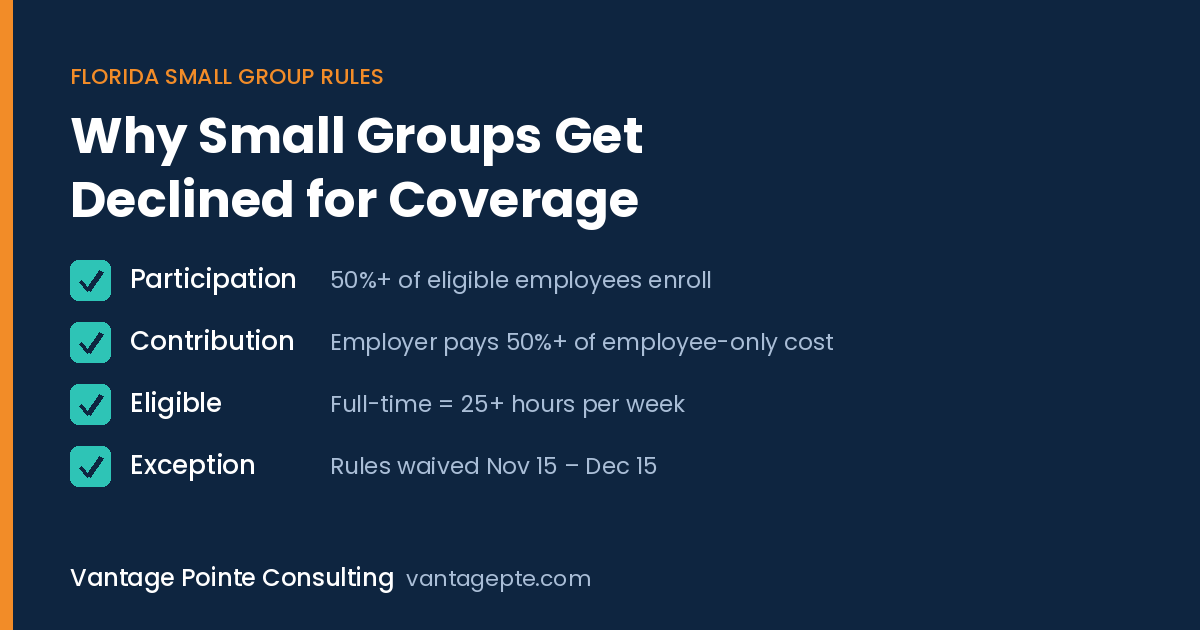
Most Florida small businesses that get turned down for group health insurance aren't declined because of their employees' health. They're declined because they don't meet the carrier's participation requirement (too few eligible employees enroll) or contribution requirement (the employer isn't paying enough of the premium). The good news: both rules are predictable, there are ways to meet them, and once a year carriers have to waive them entirely.
This guide explains how those rules work in Florida, how to calculate where your company stands, and what to do if you fall short. It's especially relevant for construction and trades companies, where younger crews, spouses with other coverage, and tight margins make these rules harder to hit.
Who counts as a "small group" in Florida?
Under Florida's Employee Health Care Access Act (Florida Statutes §627.6699), a small employer is generally a business with its principal place of business in Florida that employed an average of 1 to 50 employees during the previous calendar year and has at least one employee on the first day of the plan year. (Fla. Stat. §627.6699)
If you have more than 50 employees, you're in the large group market and the rules below work differently. If you're near 50 full-time equivalents, also read our guide to ACA employer mandate compliance.
Who is an "eligible employee"?
This is where most participation math goes wrong. Florida's statute defines an eligible employee as someone who works full time with a normal workweek of 25 or more hours and has met any waiting period. Part-time, temporary, and substitute employees are not counted. Owners, partners, and sole proprietors can be included if the plan covers them as employees.
So before you run any numbers, separate your roster into:
- Full-time employees working 25+ hours who have finished the waiting period
- Part-time, seasonal, or temporary workers (not counted)
- 1099 subcontractors (not employees, not counted)
The participation requirement
The participation requirement is the minimum percentage of eligible employees who must enroll in the plan.
Florida law doesn't set one fixed percentage. It lets each carrier set its own requirement, as long as the carrier applies it the same way to every group of the same size and doesn't raise it on you after you're approved. In practice, most Florida small group carriers require at least 50% of eligible employees to enroll, after valid waivers are removed.
What counts as a valid waiver
Florida law says a carrier cannot count employees or dependents who already have coverage through another employer-based group plan — most commonly a spouse's plan — against your participation. Those employees are removed from the math entirely.
How carriers treat other waivers — Medicare, Medicaid, TRICARE, VA coverage, or an individual Marketplace plan — varies by carrier. Some remove them; some count them as a "no." This is one reason the same group can be approved by one carrier and declined by another.
Example: the participation math
| Step | Count |
|---|---|
| Total employees on payroll | 26 |
| Minus part-time and temporary | –4 |
| Eligible employees | 22 |
| Minus valid waivers (spouse's group plan) | –6 |
| Employees counted for participation | 16 |
| Needed at 50% | 8 enrolled |
If only 6 of those 16 enroll, the group is at 38% and most carriers would decline it outside the special enrollment window. Getting just two more employees to enroll would change the answer. Carriers also round differently, so 50% of 15 might mean 7 or 8 depending on the carrier.
The employer contribution requirement
The contribution requirement is the minimum share of the premium the employer has to pay. Most small group carriers require the employer to pay at least 50% of the employee-only premium.
For example, if employee-only coverage costs $600 per month, the employer pays at least $300 and the employee pays the remaining $300 through pre-tax payroll deduction. Employers usually don't have to contribute toward spouse or family coverage, though some choose to as a recruiting tool.
Two things to know:
- The contribution percentage you choose directly affects participation. If employees are asked to pay $300 a month, younger workers are more likely to waive, which can sink your participation.
- Running employee contributions through a Section 125 plan makes them pre-tax, which lowers the real cost to the employee and helps enrollment.
For a sense of what Florida premiums actually look like, see our breakdown of group health insurance costs for small businesses in Florida [blocked].
Why construction companies get declined more often
We see the same pattern across roofing, HVAC, electrical, and general contracting companies in Southwest Florida:
- Young crews waive. A 24-year-old who rarely sees a doctor will often choose a bigger paycheck over a $250 payroll deduction.
- Mixed workforces. A mix of W-2 employees, part-timers, and 1099 subcontractors makes the eligible count confusing, and errors on the census lead to declines.
- Subsidized Marketplace plans. Some employees already have low-cost individual coverage with premium tax credits. When an employer offers coverage that's affordable and meets minimum value under IRS rules, those employees generally lose eligibility for the tax credit — which can surprise them and push them to waive or push back.
- Thin margins. Owners want to offer benefits but can't commit to 50% of the premium for every eligible employee.
We cover the recruiting side of this in benefits that attract construction workers [blocked].
The November 15 – December 15 exception
This is the most important date range most small business owners have never heard of.
Federal rules under the Affordable Care Act (45 CFR §147.104) allow carriers to enforce participation and contribution rules most of the year — but every year from November 15 through December 15, insurers in the small group market must accept groups that don't meet those rules, for coverage effective January 1. (Georgetown Navigator Guide summary)
What this means for you:
- If you've been declined for low participation or low contribution, you can apply during this window and be accepted.
- All other underwriting and paperwork requirements still apply, and carriers set tight submission deadlines. Start gathering your census and documents in early November.
- Coverage starts January 1. If you miss the window, you're back to the standard rules for the rest of the year.
The window applies to fully insured small group plans. Level-funded plans are underwritten differently and set their own requirements.
Your options if you don't meet the rules
- Use the November 15 – December 15 window for a January 1 start.
- Adjust the contribution. Sometimes moving from 50% to 60% of employee-only cost is enough to get the enrollment you need — and the extra cost is partly offset by payroll tax savings.
- Change the plan design. A lower-premium plan with a strong prescription and primary care design can raise enrollment. We explain the trade-off in our post on cheap premiums versus affordable plans.
- Consider a level-funded plan [blocked]. These often have different participation rules and can return unused claims money. See what a level-funded health plan is.
- Look at an ICHRA. With an Individual Coverage HRA, you reimburse employees for individual plans and participation rules don't apply. See ICHRA explained for Southwest Florida businesses [blocked].
- Start with voluntary benefits. Dental, vision, disability, and life insurance are employee-paid, cost the owner nothing, and build a benefits culture before you add health insurance. More options are in our guide to group health insurance alternatives [blocked].
A quick pre-application checklist
- Count eligible employees using the 25-hour rule, excluding part-time, temporary, and 1099 workers.
- Collect written waivers and note the reason for each.
- Remove employees with other employer group coverage from the participation count.
- Decide on a contribution level and calculate the employee's net cost after Section 125 savings.
- Survey employees before you apply so you know who will actually enroll.
- If you're short, mark November 15 on your calendar.
How Vantage Pointe helps
We run the participation and contribution math before anything goes to a carrier, compare which carriers treat your waivers most favorably, and tell you upfront whether you're likely to be approved. If you're not, we'll lay out the options above with real numbers so you can decide.
Been declined, or not sure you'd qualify? Request a free benefits analysis [blocked] and we'll show you where you stand before the November 15 window opens.
Frequently asked questions
What is the minimum participation requirement for group health insurance in Florida?
Each carrier sets its own, applied uniformly to groups of the same size. Most Florida small group carriers require at least 50% of eligible employees, after valid waivers, to enroll.
How much does an employer have to contribute?
Most small group carriers require at least 50% of the employee-only premium. Dependent contributions are usually optional.
Who counts as an eligible employee in Florida?
Generally, employees with a normal workweek of 25 or more hours who have met the waiting period. Part-time, temporary, and substitute employees aren't counted.
Do employees who waive coverage count against participation?
Employees covered under another employer's group plan, such as a spouse's, can't be counted against you under Florida law. Treatment of other waivers varies by carrier.
Can I get group health insurance if I don't meet participation requirements?
Yes. From November 15 to December 15 each year, small group insurers must accept groups that don't meet participation or contribution rules, for coverage starting January 1.
This article is for general educational purposes and isn't legal or tax advice. Carrier requirements vary and can change.
Sources: Florida Statutes §627.6699 · Georgetown Navigator Guide — participation rules · Georgetown Navigator Guide — contribution rules
Roger Aboytes
Licensed Benefits Consultant · Vantage Pointe Consulting · Southwest Florida
Roger Aboytes is a licensed independent benefits consultant serving individuals, families, and businesses across Southwest Florida. He helps clients compare health coverage options and design employee benefits strategies that fit their needs. Roger works directly with clients in Cape Coral, Fort Myers, Naples, Bonita Springs, and surrounding communities.
View license & credentials →