
How to Start Offering Employee Benefits: A Step-by-Step Guide for Small Businesses Under 50 Employees
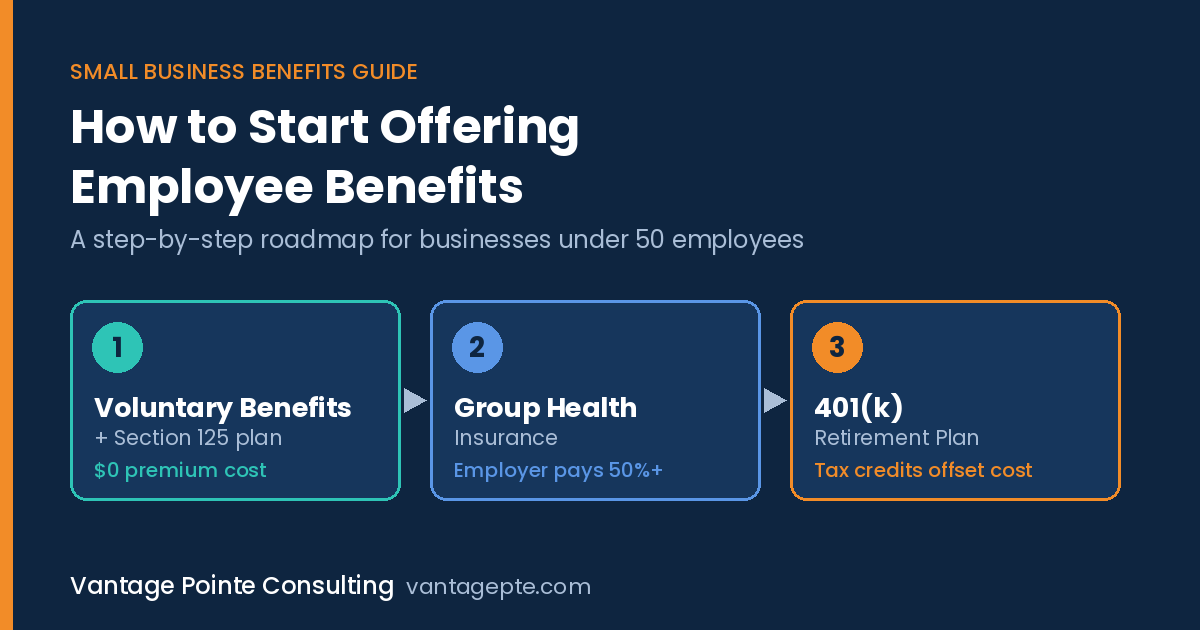
If you run a business with fewer than 50 employees and have never offered benefits, you don't have to start with an expensive health plan. The smartest path is usually to build in phases: start with voluntary benefits run through a Section 125 plan, which costs your business nothing and actually saves you payroll taxes, then add group health insurance when you're ready to contribute, and add a 401(k) using federal tax credits that cover most of the startup cost.
This guide walks through each phase — what it is, what it costs, when to add it, and the rules you need to know in Florida.
Do you have to offer benefits?
No. The ACA employer mandate only applies to businesses with 50 or more full-time equivalent employees. (Our guide to the ACA employer mandate explains how that count works.) Under 50, offering benefits is your choice.
But it's a choice that affects hiring. Skilled workers, especially in construction and the trades, compare benefits when deciding where to work, and many lost their individual coverage this year after federal premium subsidies shrank. A business that offers something has an edge over one that offers nothing. We cover the recruiting side in benefits that attract construction workers.
The three-phase roadmap at a glance
| Phase | What you offer | Cost to your business | When it makes sense |
|---|---|---|---|
| 1 | Voluntary benefits (dental, vision, life, disability, accident) through a Section 125 plan | $0 in premiums; you save 7.65% FICA on pre-tax deductions | Right away, even with 2–3 employees |
| 2 | Group health insurance | You pay at least 50% of the employee-only premium (most Florida carriers) | When you can budget for it and enough employees want it |
| 3 | 401(k) retirement plan | Startup and admin costs, largely offset by SECURE 2.0 tax credits | Any time; many owners add it alongside or before health insurance |
You don't have to follow the phases in order or wait a set number of years. The point is that you can start today without a big commitment and build up as the business grows.
Phase 1: Voluntary benefits and a Section 125 plan
What voluntary benefits are
Voluntary benefits are insurance products your employees choose and pay for themselves through payroll deduction. Because they're bought as a group, they're usually cheaper and easier to qualify for than buying the same coverage individually. Common options include:
- Dental insurance — cleanings, fillings, and major work
- Vision insurance — eye exams, glasses, and contacts
- Life insurance — protection for the employee's family
- Short- and long-term disability — replaces part of a paycheck if an employee can't work due to an off-the-job injury or illness
- Accident insurance — pays cash toward costs from injuries, a big one for active, hands-on workforces
- Critical illness and hospital indemnity — pays cash if an employee is diagnosed with a serious illness or admitted to the hospital
You pay nothing toward the premiums unless you choose to. Employees sign up for what they want.
How a Section 125 plan makes it better
A Section 125 plan (also called a cafeteria plan) is an IRS-approved arrangement that lets employees pay for qualified benefits with pre-tax payroll deductions. That does two things:
- Employees take home more. Their deductions come out before federal income tax and FICA (Social Security and Medicare), so each dollar of coverage costs them less.
- Your business saves payroll tax. You don't pay the employer's 7.65% FICA on wages that go to pre-tax benefits.
Dental and vision are almost always run pre-tax. For disability, accident, critical illness, and hospital indemnity coverage, paying pre-tax or after-tax affects whether the benefit is taxable when it's paid out, so the right choice is made product by product. Disability, for example, is often set up after-tax so the benefit check is tax-free.
What it saves: an example
Say you have 15 employees, and each puts an average of $60 a month toward dental, vision, and accident coverage through the Section 125 plan.
| Per employee per year | 15 employees per year | |
|---|---|---|
| Pre-tax deductions | $720 | $10,800 |
| Employer FICA savings (7.65%) | $55 | $826 |
| Employee tax savings (12% federal bracket + 7.65% FICA) | about $141 | about $2,120 |
Your business spends nothing on premiums and keeps roughly $826 a year in payroll tax. Your employees get coverage they want for less than they'd pay on their own. Florida has no state income tax, so these figures are federal only. For deeper tax strategy, see our post on the Section 125 tax strategy for small business owners.
What you need to set it up
- A written Section 125 plan document. The IRS requires it. Without one, the deductions don't qualify as pre-tax.
- Payroll set up for pre-tax deductions. Most payroll providers handle this easily once the plan is in place.
- An enrollment meeting. Employees enroll at the start and once a year. A short meeting, in English and Spanish if your crew needs it, makes a big difference in how many sign up.
- Nondiscrimination testing. The plan can't favor owners and highly paid employees. Testing is usually simple for small companies, but it has to be done.
One important exception: sole proprietors, partners, and owners of more than 2% of an S-Corp (and their family members on payroll) can't pay for benefits pre-tax through a Section 125 plan. They can still buy the coverage; it just won't be pre-tax for them.
For a full list of products and how they work, read voluntary benefits explained.
Why Phase 1 sets you up for Phase 2
Starting with a Section 125 plan isn't just a cheap first step. Once it's in place, employees' share of a future health insurance premium can run through it pre-tax from day one. You'll also learn how many employees actually enroll in benefits, which tells you whether you're likely to meet a health carrier's participation requirement later.
Phase 2: Adding group health insurance
Signs you're ready
- You're losing candidates or employees to companies that offer health coverage.
- Your cash flow can support a fixed monthly contribution for each enrolled employee.
- Strong enrollment in Phase 1 tells you employees value benefits.
- Key employees are asking for it.
The Florida rules to know
Most Florida small group carriers set two requirements, and the details vary by carrier:
- Participation: at least 50% of eligible employees must enroll, after valid waivers (such as employees covered on a spouse's group plan) are removed.
- Contribution: you pay at least 50% of the employee-only premium. You're usually not required to contribute toward spouse or family coverage.
In Florida, an eligible employee generally works a normal week of 25 or more hours. If you can't meet the participation or contribution rules, small group carriers must accept you anyway if you apply between November 15 and December 15 for coverage starting January 1. Our guide to Florida group health participation and contribution rules covers this in detail.
What it costs
If employee-only coverage costs $600 a month, you'd pay at least $300 and the employee would pay $300 through pre-tax payroll deduction. With eight employees enrolled, that's about $2,400 a month, or $28,800 a year, from the business — all deductible as a business expense. Real premiums depend on your employees' ages, your county, and the plan you choose. See group health insurance costs for small businesses in Florida for current ranges.
If you have fewer than 25 full-time equivalent employees with average wages under $68,200 in 2026, you may qualify for the Small Business Health Care Tax Credit, worth up to 50% of your premium contribution for two years. The catch: it generally requires a plan bought through the SHOP Marketplace, which isn't available in most areas, so ask before you count on it.
Your plan options
- Fully insured group plan: fixed premiums, simplest to run. See our group health insurance page.
- Level-funded plan: predictable monthly cost with the chance of money back in a good year. Often cheaper for healthy groups. Read what a level-funded health plan is.
- ICHRA: you give employees a tax-free allowance to buy their own individual plans. No participation rules apply. See ICHRA explained.
Phase 3: Adding a 401(k)
A 401(k) helps employees save for retirement and helps you keep them long-term. Many owners assume it's expensive to start. Under the SECURE 2.0 Act, it often isn't.
Tax credits for businesses with 50 or fewer employees
| Credit | What it covers | How long |
|---|---|---|
| Startup cost credit | 100% of eligible setup and admin costs, up to $5,000 a year (the cap is $250 per eligible non-highly-paid employee, with a $500 minimum) | First 3 years |
| Employer contribution credit | Up to $1,000 per employee earning $100,000 or less, for matching or profit-sharing contributions | 100% in years 1–2, then 75%, 50%, and 25% in years 3–5 |
| Auto-enrollment credit | $500 a year for including automatic enrollment | First 3 years |
These are tax credits, not deductions, so they reduce your tax bill dollar for dollar. All three are claimed on IRS Form 8881. (NAPA summary of SECURE 2.0 credits)
New 401(k) plans generally must include automatic enrollment, but businesses with 10 or fewer employees and businesses less than three years old are exempt. A SIMPLE IRA is another lower-cost option for very small companies, and it also qualifies for the startup credit.
Because the credits can cover most of the cost, some owners add a 401(k) before health insurance. That's a perfectly good order.
A sample roadmap for a growing contractor
| Timing | Company size | What's added |
|---|---|---|
| Now | 8 employees | Section 125 plan with dental, vision, accident, and disability |
| Year 1 | 12 employees | 401(k) with auto-enrollment, using startup credits |
| Year 2 | 18 employees | Level-funded health plan, employer pays 50% of employee-only premium |
| Year 3+ | 25+ employees | Richer contribution, dependent contributions, or added perks to compete for skilled workers |
This is an example, not a rule. Your order depends on your budget, your workforce, and what your employees ask for.
Common mistakes to avoid
- Skipping the Section 125 plan document. Without it, pre-tax deductions aren't valid.
- Offering health insurance before checking participation. If too few employees enroll, the carrier can decline you.
- Counting the wrong employees. Part-time, seasonal, and 1099 workers usually aren't eligible employees.
- Poor communication. Benefits employees don't understand don't help you recruit or retain anyone.
- Assuming a 401(k) is too expensive without checking the tax credits.
How Vantage Pointe helps
We build benefits programs in stages for small businesses across Southwest Florida, especially construction and trades companies. We set up your Section 125 plan and voluntary benefits first, run the enrollment meeting with your crew, and map out when health insurance and a 401(k) make sense for your numbers. There's no cost to you for our help with voluntary benefits.
Ready to offer your first benefits? Request a free benefits analysis and we'll build a roadmap for your company.
Frequently asked questions
Do businesses with fewer than 50 employees have to offer health insurance? No. The ACA employer mandate applies to businesses with 50 or more full-time equivalent employees.
Can I offer employee benefits at no cost to my business? Yes. Voluntary benefits are paid by employees through payroll deduction. With a Section 125 plan, those deductions are pre-tax, and your business saves 7.65% in FICA taxes on them.
What is a Section 125 plan? An IRS-approved arrangement, also called a cafeteria plan, that lets employees pay for qualified benefits with pre-tax payroll deductions. It requires a written plan document.
How much do I have to contribute to group health insurance in Florida? Most Florida small group carriers require at least 50% of the employee-only premium, and at least 50% of eligible employees must enroll. Requirements vary by carrier.
Is there a tax credit for starting a 401(k)? Yes. Employers with 50 or fewer employees can claim up to $5,000 a year for three years for startup costs, up to $1,000 per employee for employer contributions, and $500 a year for adding auto-enrollment.
This article is for general educational purposes and isn't tax or legal advice. Talk with your tax professional about your situation.
Sources: NAPA — SECURE 2.0 small employer tax credits · Small Business Health Care Credit 2026 thresholds · Florida Statutes §627.6699
Roger Aboytes
Licensed Benefits Consultant · Vantage Pointe Consulting · Southwest Florida
Roger Aboytes is a licensed independent benefits consultant serving individuals, families, and businesses across Southwest Florida. He helps clients compare health coverage options and design employee benefits strategies that fit their needs. Roger works directly with clients in Cape Coral, Fort Myers, Naples, Bonita Springs, and surrounding communities.
View license & credentials →