
Buying or Merging With Another Company: How to Combine Employee Benefits
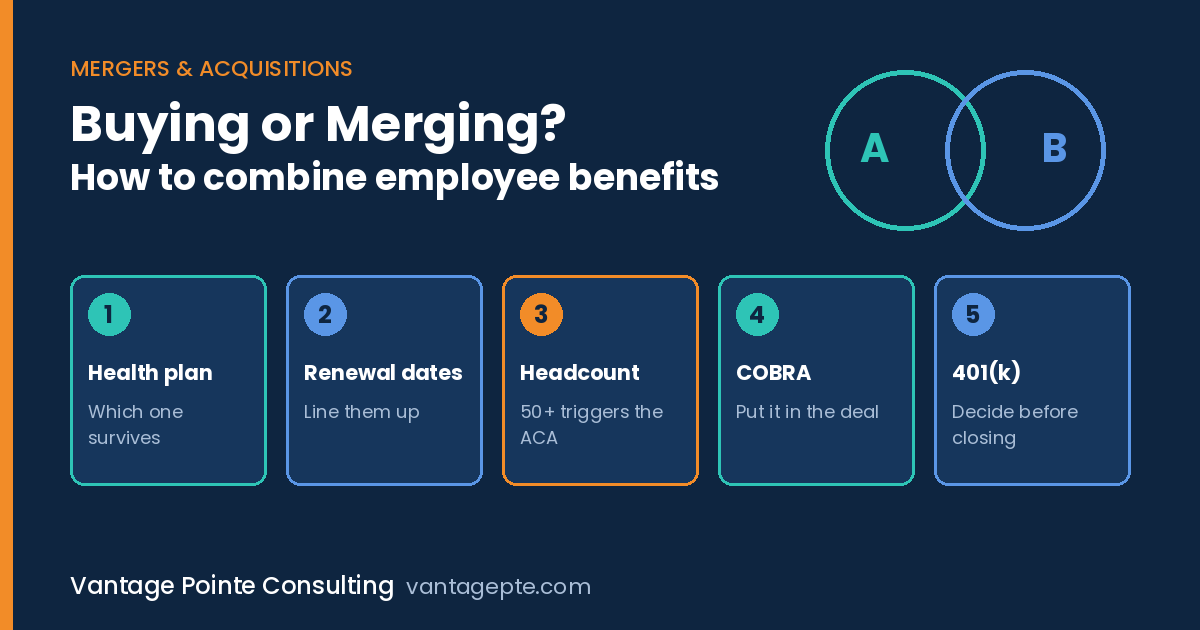
When you buy or merge with another business, you inherit its people, and with them its health plan, its 401(k), its renewal dates, and its compliance history. Most owners focus on the price and the paperwork and leave benefits until after closing. That's when the surprises show up: two health plans with different renewal dates, a 401(k) that can't be shut down the way you planned, a headcount that suddenly puts you under the ACA employer mandate, and employees who don't know if their coverage is about to change.
The short answer: look at benefits before you sign, not after you close. Decide which health plan survives, pick a date to bring everyone together, settle the 401(k) before closing, and check whether the combined company crosses the 50-employee line. This guide walks through each decision in plain language, for any industry.
Why benefits matter in a deal
Benefits are often one of a company's largest costs after payroll, and employees notice changes to them faster than almost anything else. Getting them wrong in an acquisition can lead to:
-
Employees leaving right after the deal because their coverage got worse or more expensive
-
Gaps in coverage if one plan ends before the other starts
-
Tax and penalty exposure from ACA, COBRA, or 401(k) mistakes you inherited or created
-
Paying for two of everything longer than you need to
Done well, combining benefits is also an opportunity. A larger group often has more buying power and more plan options than either company had on its own.
Step 1: Know what kind of deal you're doing
How the deal is structured changes what you inherit.
| Stock purchase (or merger) | Asset purchase | |
|---|---|---|
| What you buy | The company itself, including its legal entity | Selected assets, such as equipment, customers, and contracts |
| Its benefit plans | Come with the company. You become responsible for them. | Usually stay with the seller. Employees typically end employment with the seller and are hired by you. |
| Its past compliance problems | Generally become yours | Generally stay with the seller, with some exceptions |
| Employees' coverage on day one | Usually continues under the existing plan | Often needs a new plan ready on the closing date |
Your attorney and CPA will set the deal structure. Your job on the benefits side is to know which column you're in, because everything below depends on it.
Step 2: Do benefits due diligence before you sign
Ask the seller for these documents early:
-
Current health, dental, vision, life, and disability plans, with rates and renewal dates
-
The last one or two renewals and, if available, claims reports
-
Census data: employee ages, ZIP codes, coverage tiers, and who waives coverage
-
Employee contribution amounts and how they're paid (pre-tax through a Section 125 plan or not)
-
401(k) plan documents, recent testing results, and Form 5500 filings
-
Any PEO agreement, and its termination terms
-
A list of anyone currently on COBRA or on leave
-
ACA reporting (Forms 1094-C and 1095-C) if the company has 50 or more full-time employees
What you're looking for: rates that are about to jump, plans that don't match yours, missing documents, unpaid premiums, and anything that looks like a compliance problem. If something is missing, it's easier to get it fixed, priced into the deal, or covered by the seller before closing than after.
Step 3: Decide which health plan to keep
Most owners end up with one plan for everyone. The question is which one, and when.
| Option | When it works | Watch out for |
|---|---|---|
| Keep both plans for now | Different renewal dates, or you need time after closing | Two sets of rates and paperwork; employees doing the same job may have different benefits |
| Move everyone onto the buyer's plan | Your plan is better or cheaper and your carrier will add a new location | Deductibles may reset for new employees; confirm the new employees' doctors are in network |
| Move everyone onto the seller's plan | The seller's plan is better or its renewal is more favorable | Less common; your own employees face the change |
| Start a new plan for the combined company | Neither plan fits, or the combined group can get better pricing | More work up front; needs to be timed carefully |
Two questions usually decide it:
-
Where do employees get care? If the two companies are in different areas, one plan's network may not work for the other group. Check before you move anyone.
-
What does the combined group look like? A larger, combined census may price better, or worse, than either company alone. Get quotes for the combined group before you decide.
Step 4: Line up the renewal dates
The two companies' plans almost never renew on the same date. You have a few ways to handle that:
-
Wait for the next renewal of the plan you're keeping and bring the other group on then.
-
Switch mid-year. Small group plans can generally start on the first of any month, so you don't have to wait. Our article on switching a group plan before renewal explains how a mid-year move works.
-
Pick one renewal date for everyone going forward, such as January 1, so you only shop and enroll once a year.
When you end one plan and start another, give the outgoing carrier written notice, confirm the new plan is approved first, and make sure there's no gap in coverage. If employees switch mid-year, ask whether the new carrier will credit what they've already paid toward their deductible.
Step 5: Check your new headcount
This is the step most owners don't see coming.
The ACA employer mandate
Under the ACA, employers with 50 or more full-time employees, including full-time equivalents, must offer affordable coverage or risk penalties. Companies under common ownership are counted together. If the combined group reaches 50, every company in the group is treated as a large employer, even one that's small on its own. (IRS)
What that means for you:
-
If you're already a large employer and you buy a small company, the small company generally becomes subject to the employer mandate right away.
-
If neither company was a large employer but together you average 50 or more, plan for the mandate to apply. Large employer status is based on the prior calendar year's count, and an acquired company's history can count toward yours, so have your advisor confirm the timing.
Our guides to the ACA employer mandate and 2027 affordability safe harbors explain what the mandate requires.
Small group vs. large group
In Florida, small group health plans generally cover employers with up to 50 employees. If the combined company grows past that, your health plan may move into the large group market at renewal. Large group plans are usually priced on your own claims experience, which can help a healthy group and hurt one with large claims. It also opens up options like level-funded plans that may not have been practical before. The participation and contribution rules for small groups, covered in our Florida participation rules guide, also apply while you're still under 50.
Step 6: Handle COBRA
People who were already qualified beneficiaries under the seller's plan, and people who have a COBRA qualifying event connected with the sale, may be M&A qualified beneficiaries. Federal rules decide who has to cover them. (26 CFR 54.4980B-9)
-
If the seller keeps any group health plan after the sale, the seller generally keeps the COBRA obligation.
-
If the seller's group stops all group health coverage in connection with the sale, the buyer's group health plan generally takes over in a stock sale. In an asset sale, this applies if the buyer continues the purchased business without interruption or substantial change and maintains a group health plan.
-
The purchase agreement can assign COBRA to either side, but if the side that agreed to it doesn't follow through, the side the rules point to is still on the hook.
Get the answer in writing in the purchase agreement and make sure COBRA participants get clear instructions on where to send payments. Our article on COBRA vs. the Marketplace covers their options.
Step 7: Decide what happens to the 401(k) before closing
The 401(k) is where timing matters most, especially in a stock purchase.
-
Terminate the seller's 401(k) before closing. This is the most common approach when the buyer already has a 401(k). The seller's board approves the termination at least one day before closing, and employees can roll their balances into an IRA or your plan. The reason: if the plan is terminated after closing while you maintain your own 401(k), a tax rule called the successor plan rule can block employees from taking distributions of their own contributions. (Morgan Lewis)
-
Keep it and merge it later. If it's too late to terminate before closing, you can usually keep both plans and merge them later. Coverage-testing relief generally lasts through the end of the first plan year beginning after the deal, if the plans met the coverage rules before the deal and there is no significant change in the plans or their coverage.
-
Asset purchase: the seller's plan usually stays with the seller. You decide when the new employees can join your plan and whether to give them credit for their time with the seller.
Whichever path you choose, review the seller's 401(k) for problems first. Mistakes in a plan you merge into yours can become your problem. Learn more about our 401(k) services.
Step 8: Don't forget the smaller pieces
-
Section 125 plan. Employee premiums only stay pre-tax if there's a written Section 125 plan document covering the plan they're on. When employees move to your plan, make sure your Section 125 plan covers them. See our Section 125 guide.
-
FSAs and HSAs. Find out what happens to FSA balances and claims deadlines. HSAs belong to the employees, so they keep those.
-
Waiting periods. Ask your carrier to waive waiting periods for acquired employees so nobody goes without coverage.
-
PEOs. If the seller uses a PEO, its benefits usually end when you take over. Our guide to leaving a PEO covers the steps and notice periods.
-
Dental, vision, life, and disability. These often get forgotten. Line up their dates with your health plan where you can.
Step 9: Talk to employees early
Uncertainty about benefits is one of the fastest ways to lose people after a deal. As soon as you can share the news:
-
Tell acquired employees what stays the same and what will change, and when
-
Hold an enrollment meeting before any plan change takes effect
-
Give them a side-by-side comparison of old and new benefits
-
Name a person they can go to with questions
A sample timeline
| When | What to do |
|---|---|
| Before signing | Benefits due diligence; identify plans, renewal dates, headcount, and red flags |
| 60–90 days before closing | Get quotes for the combined group; choose which plans survive; decide the 401(k) path |
| Before closing | Terminate the seller's 401(k) if that's the plan; write COBRA responsibility into the purchase agreement; prepare employee communications |
| Closing day | Confirm coverage continues with no gap; announce benefits to employees |
| First 30–90 days | Enroll employees in the surviving plans; update payroll deductions and your Section 125 plan |
| First renewal | Move everyone to one renewal date; review ACA status and reporting for the combined company |
Example: two firms become one
A Naples professional services firm with 30 employees buys a competitor with 25 employees in a stock purchase. The buyer's health plan renews January 1; the seller's renews July 1. Both have a 401(k).
-
401(k): The buyer requires the seller to terminate its 401(k) the day before closing. Employees roll their balances into the buyer's plan or an IRA.
-
Health plan: Both groups stay on their own plans at closing. The buyer gets quotes for all 55 employees and moves everyone to one plan on January 1, with the old plan ending December 31.
-
Headcount: Together they have 55 employees. The owner confirms with an advisor when the ACA employer mandate applies and sets contributions that meet the affordability rules. At the January 1 renewal, the combined company moves into the large group market, which opens up new plan options.
-
Employees: Acquired employees get a comparison of old and new benefits and an enrollment meeting in November.
Common mistakes
-
Waiting until after closing to look at benefits
-
Terminating the seller's 401(k) after closing and running into the successor plan rule
-
Missing the headcount change that puts you under the ACA employer mandate
-
Leaving COBRA out of the purchase agreement
-
Letting coverage lapse between one plan ending and another starting
-
Not telling employees what's happening until enrollment
How we can help
We help Southwest Florida business owners, from Naples to Fort Myers and beyond, review a target company's benefits before the deal, compare plan options for the combined group, line up renewal dates, and enroll employees without gaps. We work alongside your attorney and CPA so the benefits side of the deal is handled before it becomes a problem. Learn more about our approach to group health insurance.
Planning to buy, sell, or merge? Request a free benefits analysis and we'll review both companies' benefits before you sign.
Frequently asked questions
What happens to employee benefits when a company is acquired? In a stock purchase, the company's plans usually come with it and the buyer becomes responsible for them. In an asset purchase, the plans usually stay with the seller and the buyer must have coverage ready for the employees it hires.
Do we have to combine health plans right away after a merger? No. Many companies keep both plans until a renewal date, then move everyone to one plan. Small group plans can generally start on the first of any month, so you can also combine mid-year.
Can an acquisition make us subject to the ACA employer mandate? Yes. Companies under common ownership are counted together. If the combined group has 50 or more full-time employees, including full-time equivalents, each company in the group can be subject to the mandate.
Who handles COBRA after a business sale? If the seller keeps any group health plan, it generally keeps the COBRA obligation. If the seller's group stops all group health coverage in connection with the sale, the buyer's group health plan generally takes over in a stock sale. In an asset sale, this applies if the buyer continues the purchased business without interruption or substantial change and maintains a group health plan. The purchase agreement can assign it to either side.
Should the seller's 401(k) be terminated before closing? Often, yes, when the buyer already has a 401(k). Terminating before closing generally avoids the successor plan rule, which can otherwise block employees from taking distributions of their contributions.
This article is for general educational purposes and isn't legal or tax advice. Work with your attorney and CPA on the details of any transaction.
Sources: IRS — Determining if an employer is an applicable large employer · 26 CFR 54.4980B-9 — COBRA in business reorganizations · Morgan Lewis — 401(k) plans in stock purchase transactions
Roger Aboytes
Licensed Benefits Consultant · Vantage Pointe Consulting · Southwest Florida
Roger Aboytes is a licensed independent benefits consultant serving individuals, families, and businesses across Southwest Florida. He helps clients compare health coverage options and design employee benefits strategies that fit their needs. Roger works directly with clients in Cape Coral, Fort Myers, Naples, Bonita Springs, and surrounding communities.
View license & credentials →