
Leaving a PEO: How to Move Your Employee Benefits Back In-House Without Disrupting Your Team
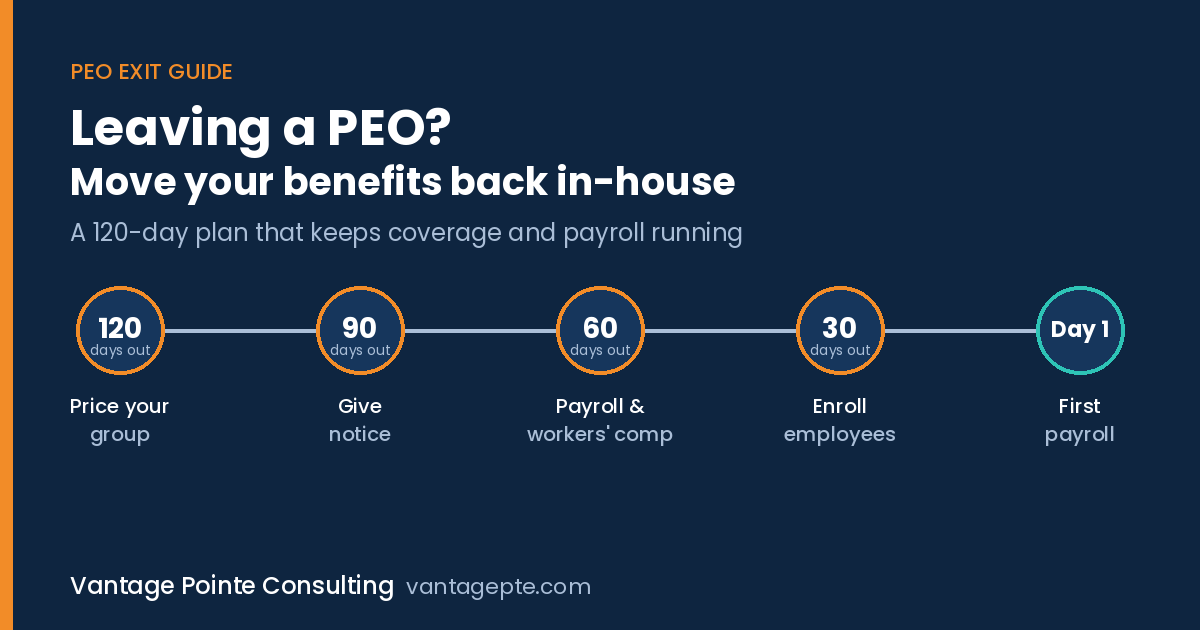
Leaving a PEO is very doable, but it has to be planned. Give yourself 90 to 120 days, line up your replacement health plan before you give notice, and time the exit to January 1 or the end of the PEO's plan year if you can. Then work through six areas in order: health benefits, COBRA, the 401(k), payroll and tax accounts, workers' compensation, and employee communication.
This guide walks through each step so your employees keep their coverage, their paychecks don't skip a beat, and you don't get surprised by fees or taxes on the way out.
What actually changes when you leave a PEO
A PEO (professional employer organization) uses a co-employment model. For payroll taxes, workers' comp, and benefits, the PEO is treated as an employer of your workers alongside you. Your employees are on the PEO's health plan, the PEO's 401(k), and often the PEO's workers' comp policy and tax accounts.
When you leave, all of that ends at once. You become the only employer, and you need your own version of each piece in place on day one. That's why a PEO exit is less about canceling a contract and more about building replacements before the old ones shut off.
If you're still deciding whether to leave, start with our comparison of a PEO vs. a benefits broker vs. an independent consultant.
Signs you've outgrown your PEO
- Your renewals keep climbing even though your own employees are healthy. On a PEO plan, your rates are tied to the whole pool, not just your group.
- You've grown past 20 to 50 employees. At that size, many businesses can buy coverage on their own for less, with more choices.
- The fees add up. Per-employee or percentage-of-payroll fees that made sense at 8 employees can be expensive at 40.
- You can't customize anything. You're limited to the PEO's plan menu, carriers, and plan year.
- You can't see your data. Most PEOs won't show you your own group's claims, so you can't tell what's driving your cost.
- Service has slipped. You're the small client in a very large book of business.
Step 1: Price your group on its own before you give notice
This is the most important step, and the one most owners skip. Never give notice until you know exactly what you're moving to and what it costs.
How your group gets priced depends on your size:
- Under 50 employees (Florida small group): ACA small group plans are priced by age and location, not by your employees' health. You can get firm quotes with just a census. Most carriers require at least 50% of eligible employees to enroll and the employer to pay at least 50% of the employee-only premium. Our guide to Florida participation and contribution rules covers the details.
- Level-funded plans: often cheaper for healthy groups, but usually require short health questionnaires or claims data to price. See what a level-funded health plan is.
- 50+ employees: large group carriers want claims history. Ask your PEO for your group's claims and enrollment reports early. Some will provide them; some won't, which affects which options you can price.
Compare your total PEO cost (premiums plus admin fees plus any markup) against your total standalone cost (premiums plus payroll software plus workers' comp plus any HR support you'll buy). That's the real comparison.
Step 2: Choose your exit date
| Exit timing | Pros | Watch out for |
|---|---|---|
| January 1 | Deductibles and payroll tax wage bases reset anyway; clean year-end reporting | Small group carriers and payroll setup get busy in December, so start early |
| End of the PEO's plan year | Avoids a mid-year deductible reset for employees | Payroll taxes may restart mid-year |
| Mid-year | Faster savings if the PEO renewal is bad | Employees' deductibles may reset; Social Security and unemployment tax wage bases may restart under your own EIN, so you can pay those taxes twice on higher earners |
The payroll tax issue surprises a lot of owners. Social Security and state unemployment taxes stop once an employee earns past the year's wage base. When you leave a PEO mid-year, your company may be treated as a new employer for those taxes, and the count can start over. For a crew of well-paid foremen and project managers, that adds up.
Step 3: Read your PEO contract
Before you give notice, pull the contract and confirm:
- Notice period: many PEO contracts require 30 to 90 days' written notice.
- Termination fees or minimum terms.
- Final invoice: how prorated fees, workers' comp adjustments, and benefits reconciliation are handled.
- Data access: how and when you'll receive payroll history, year-to-date wages, tax filings, deduction records, and personnel files. Get everything exported before your access ends.
Once a PEO knows you're leaving, it has less reason to bend to your timeline. Have your replacements lined up first.
Step 4: Replace your health benefits
Your options are the same as any business setting up its own plan:
- Fully insured group plan: fixed premiums, simplest to run. See our group health insurance page.
- Level-funded plan: predictable monthly cost with money back in a good year. See our level-funded health plans page.
- ICHRA: a tax-free allowance employees use to buy individual plans, with no participation requirement. See ICHRA explained.
A few details to handle:
- Waiting periods: ask the new carrier to waive the waiting period for current employees so there's no gap.
- Deductible credit: if you leave mid-year, ask whether the new carrier will credit what employees already paid toward their deductibles.
- Section 125 plan: the PEO's cafeteria plan ends when you leave. You need your own written Section 125 plan document so employee premiums stay pre-tax. See our Section 125 tax strategy guide.
- FSA and HSA: find out what happens to FSA balances and the claims run-out deadline. HSAs belong to employees, so they keep those.
- Open claims: if the PEO plan was self-funded, confirm how claims incurred before your exit will be paid.
If your group is under 50 and has trouble meeting participation, remember that Florida small group carriers must accept groups regardless of participation and contribution if you apply between November 15 and December 15 for a January 1 start.
Step 5: Settle COBRA responsibility
In many cases, the PEO keeps COBRA responsibility for anyone already on continuation coverage before you leave. But contracts vary, so get it confirmed in writing. Former employees on COBRA need clear instructions about where to send payments and who to call.
Going forward, COBRA becomes your responsibility for your own plan. If you have fewer than 20 employees, federal COBRA generally doesn't apply to your new plan, but Florida's state continuation law does, and the insurance carrier handles much of the administration.
Step 6: Move the 401(k)
The 401(k) usually takes longest. Most PEO retirement plans are multiple employer plans that cover many client companies. When you leave, there are generally two paths, depending on the PEO's plan rules:
- Spin-off: your employees' accounts move as a group into a new 401(k) you set up.
- Termination and rollover: your participation in the PEO plan ends, and employees roll their balances into an IRA or into your new 401(k) plan.
Either way, set up your new 401(k) before the PEO's payroll stops so employee deferrals continue without a break. Ask whether SECURE 2.0 startup credits apply to your new plan; past participation in the PEO's plan can affect eligibility. Our first-time benefits guide explains those credits.
Step 7: Set up payroll, tax accounts, and workers' comp
Payroll. Choose a payroll provider and load accurate year-to-date data from the PEO. Employees will need to fill out new direct deposit forms and W-4s, even if nothing has changed for them.
Tax accounts. You'll need your own federal payroll tax setup and a Florida reemployment (unemployment) tax account with the Florida Department of Revenue. Florida has no state income tax, so there's no state withholding account to open, but if any employees work in other states, you may need accounts there.
Workers' compensation. This is the one area where a gap is not acceptable. Bind your own policy effective the same day the PEO's coverage ends. Some carriers treat a company coming off a PEO as a new business because it never had a policy in its own name, which can affect pricing. Request your loss runs and payroll by class code from the PEO early. For construction and trades companies, start this at least 60 days out.
Year-end reporting. Decide who files W-2s and ACA forms (1094/1095) for the part of the year you were with the PEO. If you have 50 or more full-time equivalents, ACA reporting becomes yours. See ACA employer mandate compliance.
Step 8: Tell your employees
Employees mostly want to know three things: Will I have coverage? Will my paycheck change? Can I keep my doctor? Answer those early and in writing.
- Announce the change once the replacement plan is confirmed, not before.
- Hold an enrollment meeting, in English and Spanish if your crew needs it.
- Explain new ID cards, the effective date, and what happens to deductibles.
- Collect new payroll paperwork before the first payroll.
- Tell them where to direct questions during the transition.
For tips on benefits communication with field crews, see health insurance for construction companies in Florida.
A 120-day PEO exit timeline
| When | What to do |
|---|---|
| 120 days out | Review the PEO contract; request claims and payroll data; get health plan quotes |
| 90 days out | Choose the replacement plan and exit date; give written notice per the contract |
| 60 days out | Bind workers' comp; set up payroll provider and tax accounts; start the 401(k) transition; adopt a Section 125 plan |
| 30 days out | Employee meetings and enrollment; collect W-4s and direct deposit forms; confirm COBRA handoff in writing |
| Exit date | New coverage starts; run your first payroll and reconcile it against the PEO's final payroll |
| After exit | Archive PEO records; confirm final invoice; handle year-end W-2 and ACA reporting |
Common mistakes to avoid
- Giving notice before pricing the replacement plan.
- A gap in workers' comp coverage, even for a day.
- Leaving mid-year without checking the payroll tax wage base impact.
- Forgetting the Section 125 plan, which makes employee premiums taxable.
- Losing access to PEO records before exporting payroll and tax history.
- Telling employees too late, or before the new plan is confirmed.
How Vantage Pointe helps
We help Southwest Florida businesses, especially construction and trades companies, move off PEOs without disrupting their teams. We price your group on its own first, so you know whether leaving actually saves money. If it does, we design your replacement plan, coordinate the timing with your payroll provider and workers' comp agent, set up your Section 125 plan, and run the employee enrollment meetings.
Wondering whether your PEO is costing you more than it should? Request a free benefits analysis and we'll compare your PEO against the open market.
Frequently asked questions
How long does it take to leave a PEO? Plan for 90 to 120 days to price a replacement plan, give notice, set up payroll and workers' comp, and enroll employees.
When is the best time to leave a PEO? January 1 is usually best because payroll tax wage bases and deductibles reset anyway. The end of the PEO's plan year is the next best option.
Who handles COBRA after leaving a PEO? In many cases the PEO keeps responsibility for people already on COBRA before you leave, but it depends on the contract. Get it in writing.
What happens to my employees' 401(k)? Depending on the PEO's plan, accounts are either spun off into your new plan or employees roll their balances into an IRA or your new 401(k).
Will health insurance cost more after leaving a PEO? Not necessarily. Many groups pay less on their own because they stop sharing the PEO pool's renewals and fees. Price your group before you decide.
This article is for general educational purposes and isn't legal or tax advice. PEO contracts and plan rules vary, so review yours with your advisors.
Sources: Mosey — Exiting a PEO · BPM — PEO transition checklist · IntegrityHR — PEO exit strategy
Roger Aboytes
Licensed Benefits Consultant · Vantage Pointe Consulting · Southwest Florida
Roger Aboytes is a licensed independent benefits consultant serving individuals, families, and businesses across Southwest Florida. He helps clients compare health coverage options and design employee benefits strategies that fit their needs. Roger works directly with clients in Cape Coral, Fort Myers, Naples, Bonita Springs, and surrounding communities.
View license & credentials →